








Hey parents!
Has your living room once again become a “disaster zone”? Pillow mountains, blanket valleys, your little explorer turning the place upside down—sound familiar?
Relax. You might not realize it, but your tiny climber is actually performing a vital “brain and body development project”. Today, we’ll show you how to transform your living room into a safe adventure playground, turning seemingly risky climbing into smart motor skill training. 
Why Toddlers Are Obsessed With Climbing
Before labeling your child as “too wild,” remember this is hardwired in their growth instincts. Human toddlers have a natural drive to explore space—they learn by moving through it, building a neural-muscle communication network.
When toddlers climb on couches, they’re executing a complex “neurological operation”:
- Their vestibular system calculates balance
- Their proprioceptive system tracks body position
- The cerebellum coordinates muscles
- Vision gauges distances

Even a simple climb is like a full-body brain-and-muscle rehearsal. Next time your child is “wrecking” the couch, repeat to yourself: “This is essential! This is essential! This is essential!”
Living Room Makeover: Building a Safe Climbing Base
Step 1: Safety First
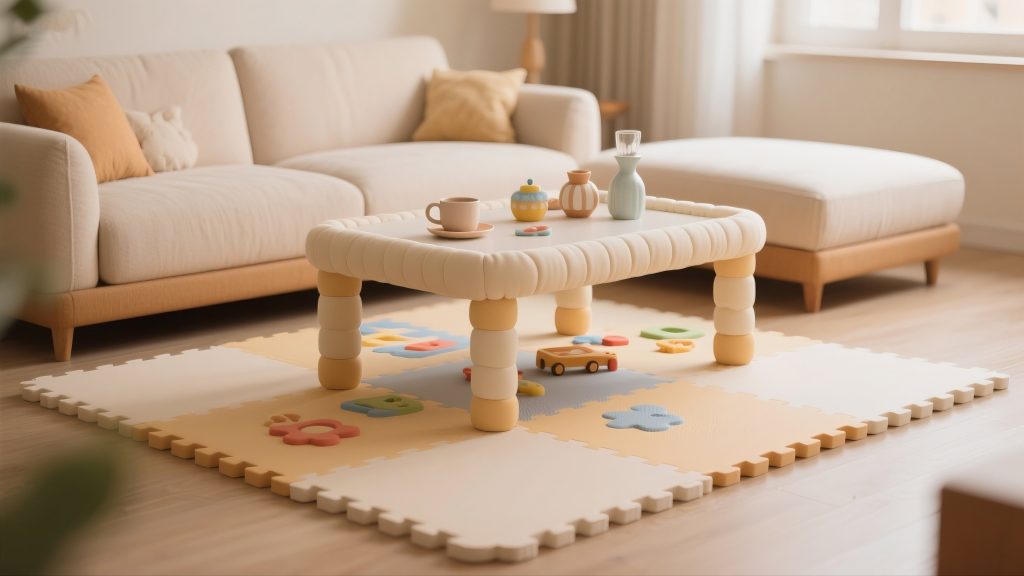
- Floor padding: Lay a 5cm-thick play mat in front of the couch, bigger than the couch footprint
- Edge protection: Wrap all sharp corners with bumpers, especially coffee tables
- Clear hazards: Move hot drinks, breakables, and fragile items above 1.2 meters
- Safety buffer: Keep at least 1 meter of free space around the couch
5 Couch Climbing Games That Supercharge Toddler Skills
Game 1: Cushion Mountain Climb (Ages 1–2)
- Setup: Stack 3–5 cushions of varying thickness and firmness in front of the couch
- Play: Guide toddlers from the smallest cushion to climb up to the couch “peak”
- Motor skills benefit: Develops bilateral coordination, which supports future tasks like writing or dressing
- Safety tips:
- Cushions snugly together, no gaps
- Always stand below for support
- Start low (≈10cm) for first attempts

Game 2: Couch Armrest Balance Beam (Ages 2–3)
- Setup: Remove back cushions to reveal flat armrests
- Play: Toddlers crawl, squat-walk, or even stand along the armrest
- Brain boost: Activates the vestibular system, improving balance and focus
- Fun alert: Capture wobbly moments—they make perfect family video clips!

Game 3: Blanket Tunnel Adventure (Ages 1.5–3)
- Setup: Anchor one end of a blanket to the couch, elevate the other end with a chair to create a tunnel
- Play: Hide soft toys or healthy snacks as treasures inside
- Hidden skills: Enhances spatial awareness and motor planning—foundations for future reading and math
- Parent trick: Reward toddlers with small treats at the tunnel end for extra motivation

Game 4: Pillow Fortress Siege (Ages 2–4)
- Setup: Build a fortress from couch cushions and pillows with “windows” at different heights
- Play: Toddlers climb through, slide down, or jump off
- Social benefits: Teaches turn-taking, cooperation, and following rules naturally
- Emotional growth: Safe risk experiences teach emotional regulation

Game 5: Couch Obstacle Course (Ages 2.5+)
- Setup: Combine floor climbing → couch jumps → slides → crawl under coffee table → return
- Training: Covers all gross motor skills: climbing, jumping, sliding, crawling
- Track progress: Time each course monthly; improvements are easy to spot and rewarding

Climbing Progression by Age
Phase 1: Exploration (1–1.5 years)
- Goal: Build confidence, not fear
- Method: Parent support and verbal encouragement
- Tip: “Mom is right here to protect you”
Phase 2: Skill Building (1.5–2.5 years)
- Goal: Master basic climbing techniques
- Method: Demonstrate and break down actions step by step
- Tip: “Watch how I do it”
Phase 3: Creative Play (2.5+ years)
- Goal: Design their own games, problem-solve independently
- Method: Ask guiding questions
- Tip: “You have a great idea!”

When to Pause
Even fun climbing requires caution:
- If the child shows fear or resistance
- Visiting guests—avoid imitation accidents
- Fatigue, illness, or immediately after eating
- Loose or damaged furniture
Long-Term Benefits: From Couch to Life Skills
Climbing games equip toddlers with essential life skills:
- Body confidence: “I can control my body”
- Risk assessment: “I can try this height safely”
- Problem-solving: “How do I climb safely?”
- Resilience: “I didn’t succeed—next time I will”
Brain-derived neurotrophic factor (BDNF) released during exercise promotes neural connections, enhancing learning efficiency. Active toddlers really are smarter!
Start Today!
Don’t despair over a “messy” couch. Transform your living room into a safe adventure playground and create climbing games that grow with your child.
Remember: The best exercise space isn’t a fancy class—it’s the living room with your guidance. The best teacher isn’t a coach—it’s you playing alongside them.
Mom’s philosophy: “Instead of yelling ‘don’t climb!’, design games that let them climb better.”
Safety reminder: Always supervise all activities and adjust difficulty to your child’s abilities.