





Becoming a parent during the first year often feels like living inside a whirlwind of diapers, sleep schedules, and growth charts. Just when your baby finally learns to walk and say “mama,” a new wave of worries appears.
You might catch yourself thinking:
“Why does my child just stare at other kids like a tiny observer?”
“When someone takes his toy, he doesn’t react. Is he too timid?”
“At the playground he clings to me. How will he survive preschool?” 
Take a deep breath. These concerns are incredibly common.
Today we’re diving into a question that makes many new parents anxious: how do you create social play opportunities for a one-year-old?
Before jumping into strategies, it helps to understand what’s actually going on inside that little brain attached to your wobbling, penguin-walking toddler.
What Looks Like “Ignoring Others” Is Actually Social Training
Many parents feel puzzled during playdates. Other kids are running around chasing each other, while their own toddler quietly sits in the sand, poking at toys.
Is the child antisocial?
Not at all.
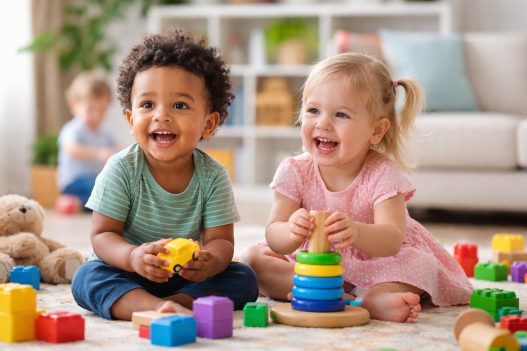
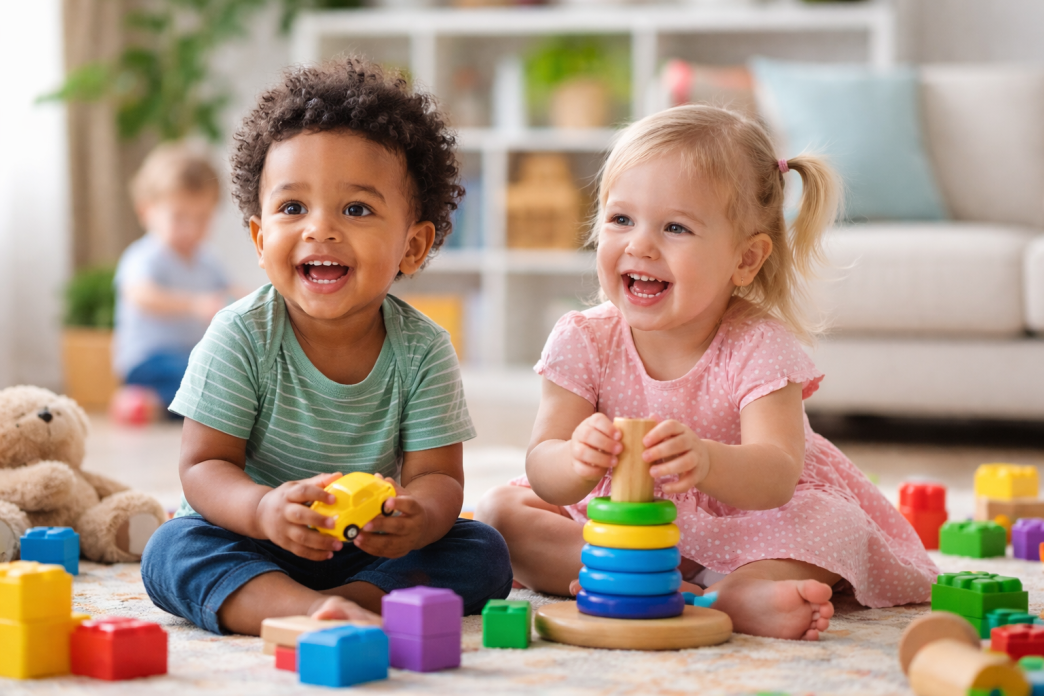
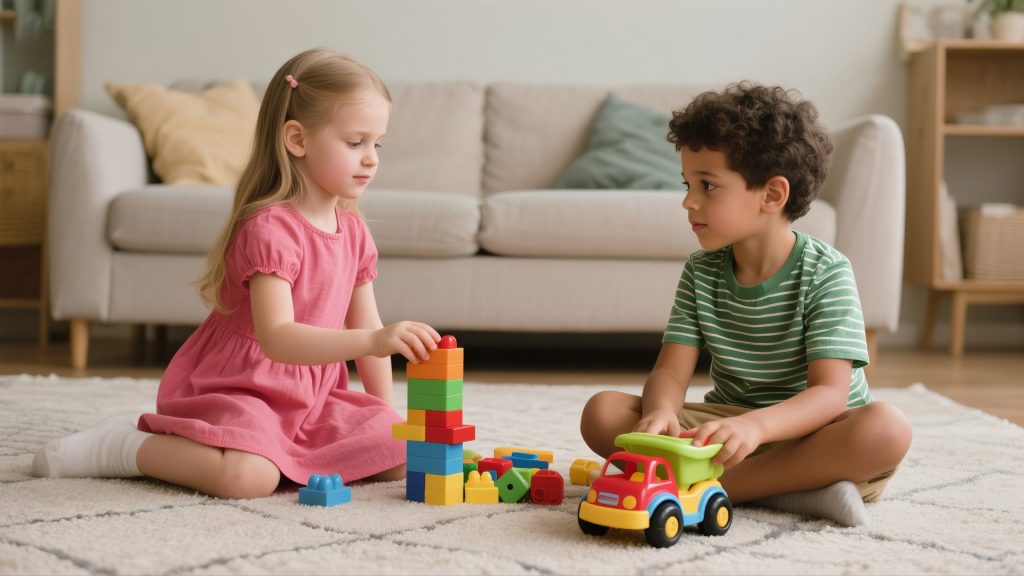
In Developmental psychology, there’s a well-known concept called Parallel play.
Parallel play describes a stage where children play side by side without directly interacting. They may glance at each other occasionally, but each child remains focused on their own activity.
To adults, this can look like pointless socializing.
To toddlers between 0 and 2 years old, however, this is perfectly normal—and extremely important.
Other children act less like playmates and more like fascinating mirrors. Your toddler might be thinking:
“Wait… he’s stacking blocks too.”
“Why does that toy car look different from mine?”
They are observing, comparing, and absorbing information.
Here’s the golden rule: sometimes the most supportive thing parents can do is simply step back.
If your child is deeply engaged in this quiet form of observation, resist the urge to say, “Go say hi!” or “Shake hands with the other kid!”
That gentle pressure can accidentally extinguish the tiny spark of early social curiosity.
Creating Opportunities for Social Play
Understanding toddler behavior is only half the story. If we want to nurture social skills, we also need to create the right environment.
Here are some practical strategies that actually work.
Choose the Right Playmate
Many parents automatically look for children the same age as their toddler.
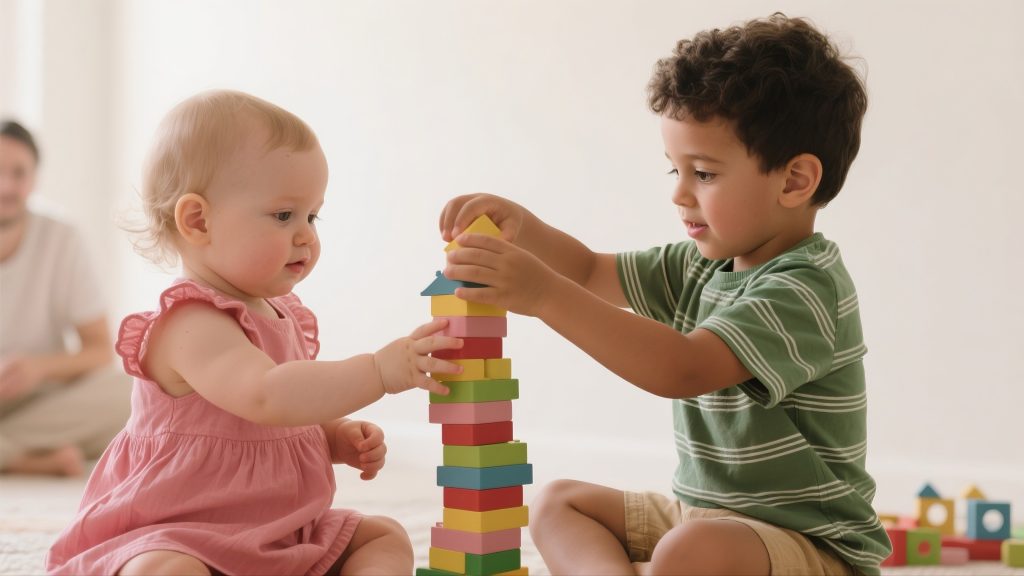
But surprisingly, a slightly older child—perhaps one or two years older—can be a fantastic social guide.
Older kids naturally attract attention. Their more advanced activities, such as building block towers or pretending with toys, become powerful learning examples for younger toddlers.
At the same time, older children are often more tolerant of a baby’s clumsy curiosity.
Instead of two one-year-olds fighting over a teething toy, a calm older child can gently lead the interaction.
Location Matters: Home vs. New Places
This is a lesson many parents learn through trial and error.
For a child’s first social play experiences, it’s best to choose a familiar environment—ideally your own home.
Around the age of one, toddlers rely heavily on a behavior known as Social referencing. When they encounter something unfamiliar, they instinctively look to their parents’ faces for emotional guidance.
In unfamiliar spaces, their brains prioritize safety over social exploration.
But at home, things feel different. The toys belong to them, the environment feels predictable, and their confidence grows.
Once a child feels secure, curiosity about other children naturally begins to emerge.
The “Double Toy Rule”
Parents often try to teach sharing very early.
But the truth is that sharing is an advanced social skill, one that depends on brain development.
Forcing a one-year-old to share is a bit like asking a child who just learned basic math to solve calculus.
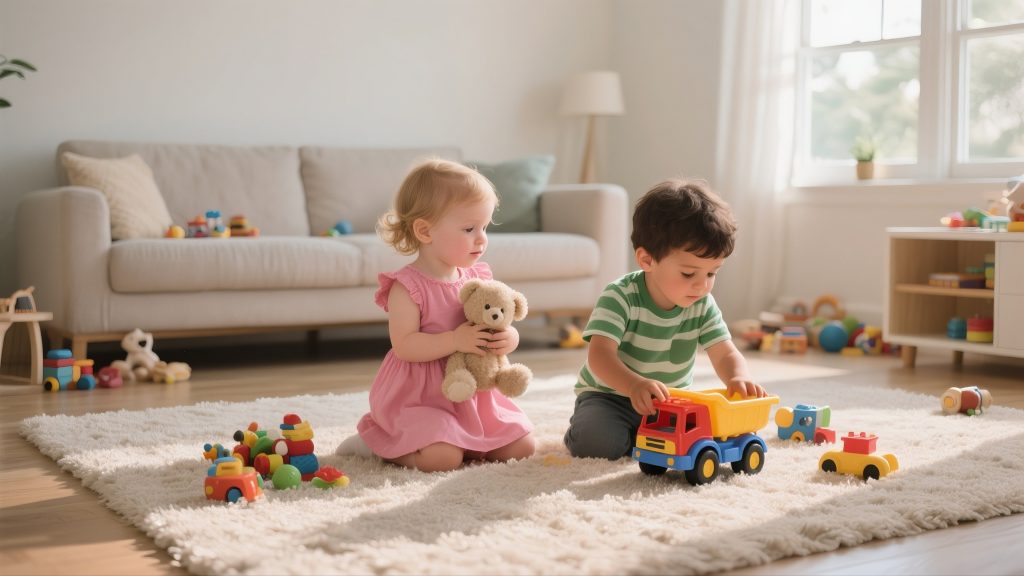
Instead, follow a simple rule: always prepare twice as many toys as you think you need.
If two toddlers are playing together, bring at least four appealing toys.
Why?
Because one universal toddler law always applies:
Someone else’s toy is always more interesting.
Having extra toys ready allows you to smoothly redirect attention before small conflicts escalate.
When Conflict Happens, It Becomes a Learning Moment
Whenever two toddlers meet, some drama is almost guaranteed.
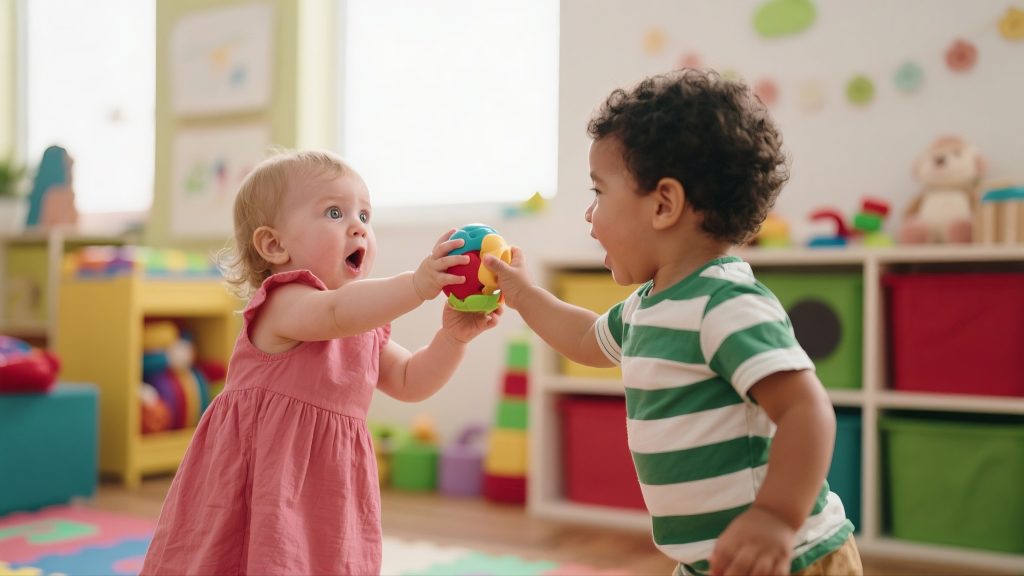
Toy grabbing. Pushing. Occasionally even biting.
Many parents feel embarrassed or stressed during these moments.
But here’s an important perspective shift: conflict is actually a valuable learning opportunity.
Research in Neuroscience shows that during early childhood, the brain grows rapidly like a developing rainforest. Experiences—especially emotional interactions—help shape neural connections.
Repeated social experiences help develop the Prefrontal cortex, the brain region responsible for self-control, empathy, and understanding rules.
When conflict occurs, parents shouldn’t act like judges.
Instead, act like translators.
Kneel down, comfort the upset child, and calmly explain the situation in simple language:
“Baby is crying because the teddy bear was taken. He feels sad. Maybe we can trade with this rattle instead?”
Are you performing a little show?
Not really.
You’re helping install the basic programming of empathy in both children’s developing brains.
Social Development Is Really About Parents Stepping Back
At the end of the day, there’s something important many parents forget.
We search for playmates, organize playdates, and enroll our children in activities because we hope they will one day build happy relationships.
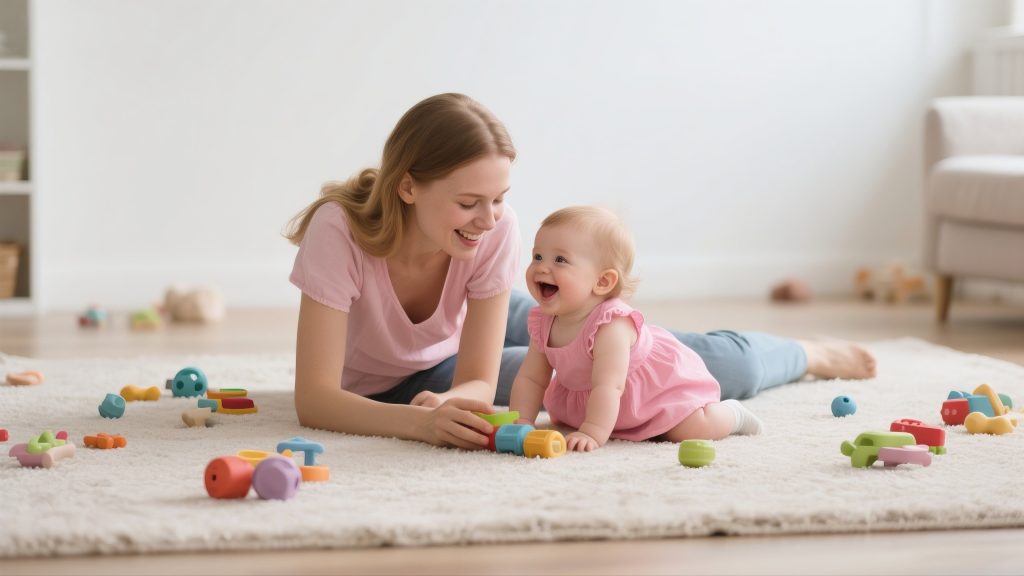
But for a one-year-old, parents are still the most important playmates in the world.
Your silly facial expressions while playing together, or the way you warmly greet a neighbor with “Good morning,” can teach social skills more powerfully than any planned playdate.
Creating opportunities for social play isn’t about turning your child into an ultra-social extrovert.
It’s about quietly planting a small seed in their heart:
The world is big.
There are many interesting people beyond mom and dad.
And kindness and friendship exist everywhere.
So relax.
Even if a playdate ends in tears and toy battles, that’s okay.
The next time those toddlers meet, the seed of friendship might just begin to sprout.