








Have you ever noticed this?
For months, your baby barely says a word. You talk all day long, and all you get back is a soft “uh” or “mm.”
Then one day—boom. 
“Mommy.”
“Up.”
“No.”
“More.”
“Car.”
“Woof.”
It feels like someone flipped a hidden switch.
You’re excited… and slightly suspicious: Did my child secretly enroll in a speech class?
Relax—this isn’t magic.
Around ages 1 to 2, many children enter what experts call a “language explosion” phase, a period in early Language acquisition where vocabulary grows at a surprising speed.
But here’s the real question:
Why do some kids take off like rockets, while others are still stuck at “uh-huh”?
The answer usually isn’t talent—it’s what happens in everyday interactions.
Today, you’ll get a simple, repeatable daily system. No textbooks. No expensive classes. Just 10–20 minutes a day to steadily boost your child’s vocabulary.
Language Growth Isn’t Instant—It’s Stored, Then Released
Many parents quietly worry:
- “Is my child talking late?”
- “Other kids are reciting songs—mine just babbles.”
- “Do I need intervention?”
Here’s the truth:
Language development works like saving money.
At first, you don’t see the balance growing—but deposits are happening every day.
Then one day, it hits a threshold… and suddenly, words start pouring out.
During this phase, what matters most isn’t forcing your child to speak—it’s how much high-quality language input they receive.
In other words:
That “explosion” is built quietly, day by day.
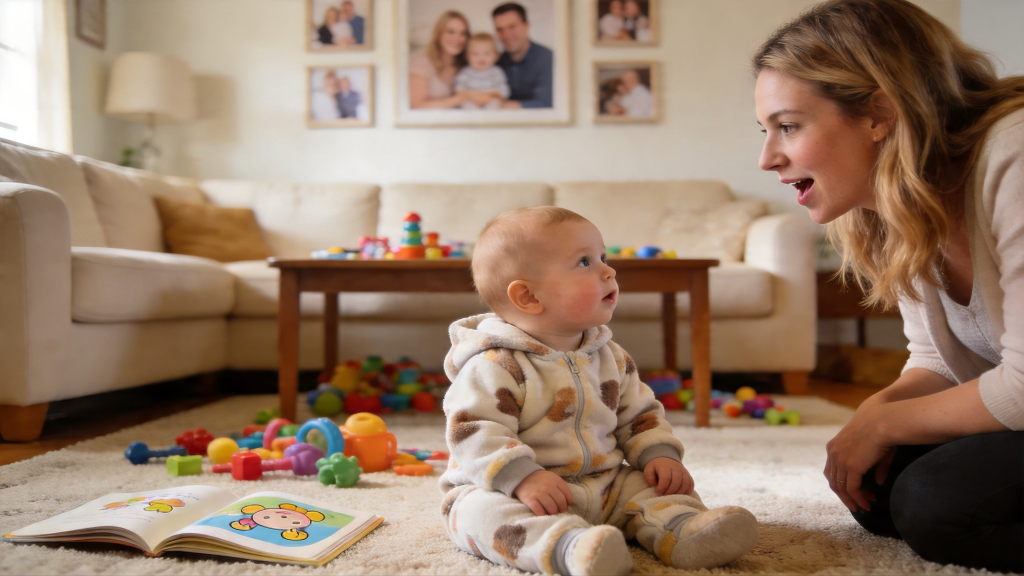
The Real Problem: Not Fewer Words—But Fewer Usable Words
Learning a word isn’t just hearing it once.
Your child needs to:
1. Understand it
2. Use it
3. Apply it across situations
That’s why your child might understand “shoes,” “water,” or “go out”… but still not say them.
It’s not that they can’t—it’s that the word hasn’t become a ready-to-use tool yet.
Your goal isn’t just exposure.
It’s turning words into something your child can actively use.

The Core Strategy: 3 Principles That Change Everything
Before techniques, lock in these three rules:
1. Be specific, not vague
“Pretty!” → less useful
“That red car is moving!” → much better
2. Talk about the present
Skip abstract ideas.
Start with: “Hi,” “Thank you,” “Bye.”
3. Keep it short
Long explanations confuse toddlers.
Short sentences stick.
6 Daily Habits That Trigger a Vocabulary Leap
1. The “Follow & Say” Rule (3-second response)
Your child’s attention moves fast—like a butterfly.
The moment they focus on something, you label it.
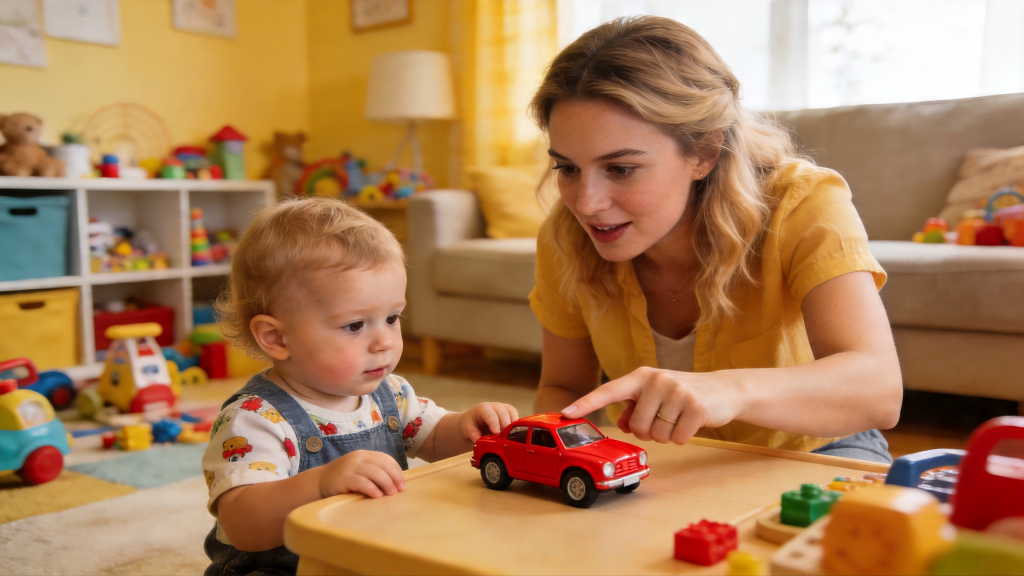
- Child points at a car → “Car! Yellow car!”
- Child touches a dog → “Dog! Woof woof!”
This is called joint attention, a key concept in Developmental psychology and one of the most powerful gateways to language learning.
2. One Word, Three Situations
Don’t teach a word once—repeat it across contexts.
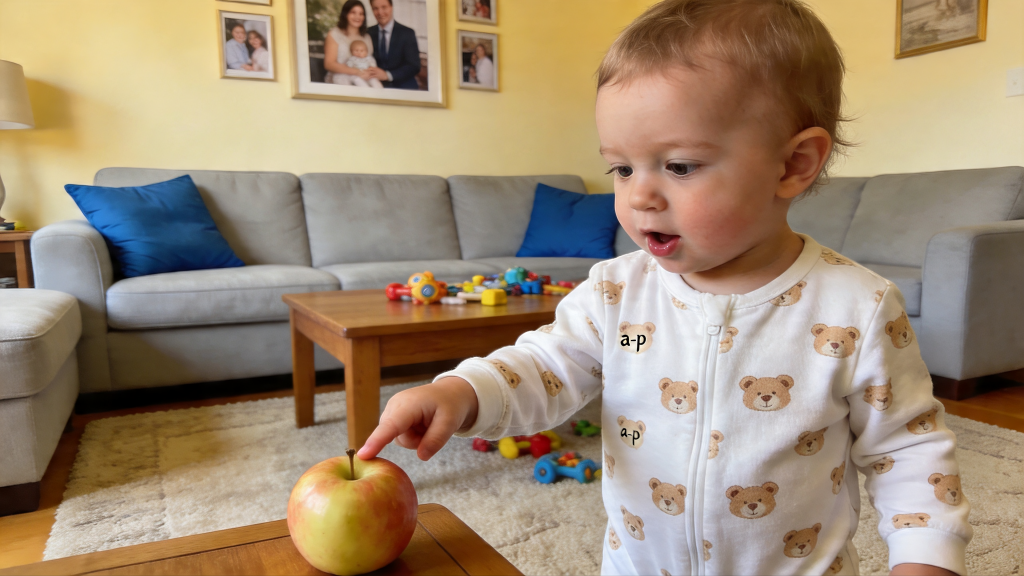
Example: “Apple”
- Eating → “Take a bite of the apple.”
- Shopping → “Let’s buy apples.”
- Drawing → “Draw an apple.”
Repetition across real-life moments helps the brain mark it as a high-value word.
3. Expand What They Say
When your child says one word, upgrade it.
- Child: “Car!”
- You: “Red car is going!”
- Child: “Up!”
- You: “Mommy picks you up.”
This technique is known as scaffolding in Scaffolding (education).
You’re not correcting—you’re building.
4. Ask Choice Questions
Avoid yes/no questions.
Instead of:
“Do you want water?”
Try:
- “Water or milk?”
- “Banana or apple?”
This activates decision-making and encourages speech.
Keep it simple: no more than two choices.
5. Be a “Live Narrator”
You don’t need tons of books—daily life is your best teaching tool.
Turn routines into language:
- Changing clothes → “Pants off—wipe—new diaper—done.”
- Going out → “Jacket—hat—keys—door.”
This connects words directly to actions—exactly how early Cognitive development works.
6. 10 Minutes of Interactive Reading
Reading isn’t about finishing the book—it’s about engagement.
Try this simple 3-step method:
- Point → “What’s this?”
- Answer → “It’s a cat. Meow.”
- Act → “Touch the cat.”
Once your child participates, words become meaningful—not just background noise.
The Biggest Mistakes Parents Make
Don’t force repetition
“Say ‘apple’ after me.”
→ Silence. Avoidance.
Because it feels like a test—not communication.
Kids speak when it works for them—when they’re understood, responded to, and rewarded.
Don’t rely on screens
Yes, shows expose kids to words.
But without interaction, there’s no feedback loop.
Language grows through social interaction, not passive listening.
A Simple 10–20 Minute Daily Plan
Morning (3 minutes)
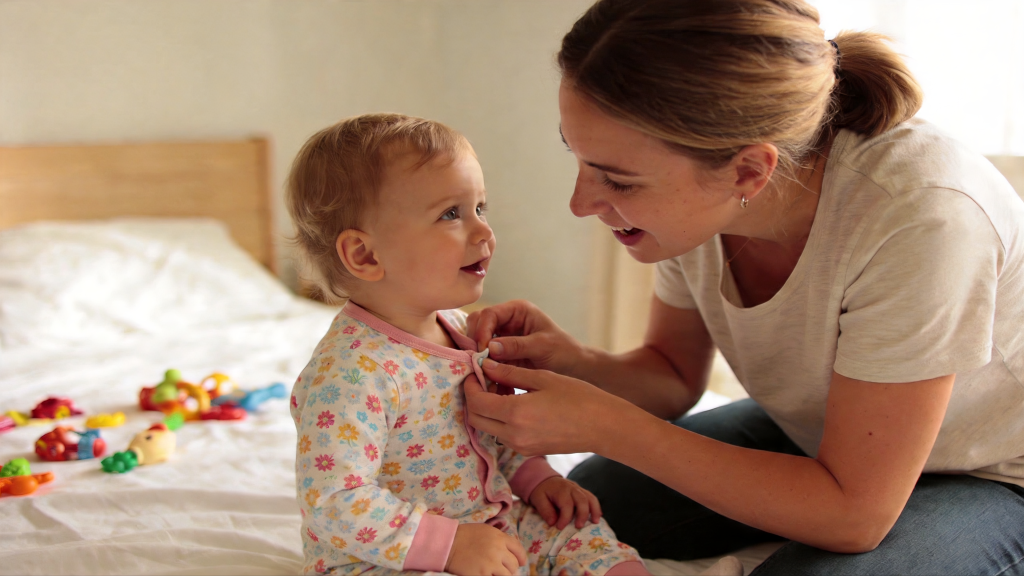
Getting dressed:
“Socks, pants, shirt, zipper.”
Daytime (5–10 minutes)
Playtime:
Use “Follow & Say” + expansion.
Evening (5–10 minutes)
Reading + choice questions:
“Bear or bunny?”
“What is the bear doing—eating or sleeping?”
Stick with this for two weeks, and you’ll notice something powerful:
Your child doesn’t just know words—they start using them to express, request… even boss you around.

When Should You Pay Extra Attention?
Most children develop at different speeds—but check in if you notice:
- Weak response to sounds or name
- Minimal eye contact or pointing
- Very few meaningful words by 18 months
- Loss of previously used words
If needed, consult a pediatric specialist familiar with Speech delay for reassurance.
Final Thought: Language Isn’t Taught—It’s Shared
Don’t turn language into a training camp.
Those small daily moments—following your child’s attention, expanding their words, narrating life—are quietly wiring their brain.
You’re not just teaching words.
You’re building a voice.